So, I’ve decided that for the entirety of this process I will no longer think negatively, (definitely won’t happen). But even if the worst does happen and I can’t run the marathon; I’ve realised it doesn’t mean I’ve failed, it just means it will take me a bit longer than everyone else to complete 26.2 miles.
I went to physio on Friday the 6th of March, and while it wasn’t as helpful as I was hoping, I did take one significant factor away. I need to scrap everything I’ve done up to this point, put my ego aside, and start again, setting myself new achievable goals. Which, I now realise probably should have been one of my first blogs, for many important reasons, but you live and you learn.
I’ve named the first stage of goal setting the rehabilitation phase, defined as a problem-solving process delivered by a multi professional team, including numerous treatments, actions and activities (Bovend’Eerdt, Botell, & Wade, 2009). Per Sheil and colleagues (2008) a goal-planning process should be used to guarantee that every individual involved, particularly the patient, agree on the goals of rehabilitation and the methods used to manage these goals, as well as every individuals role in the process. Additionally, it is well recognised that goal setting instigates behavioural change in individuals (Bovend’Eerdt, Botell, & Wade, 2009). For me, setting appropraite goals has been an apparent weakness throughout this process for example, by over training early on in the process and attempting to go back to training even when my body was evidently not ready. For me this has been a massive learning curve by highlighting the need for recovery and that training is quite literally a marathon not a sprint.
Consequently, certain characteristics of goals need to be met for effective goal setting (Hurn, Kneebone, &, Cropley, 2006), such as:
1) The goal should be relevant to the given individual
2) The goal should be achievable, realistic and relevant, yet challenging
3) The goal should be specific thus allowing the goal to be measured
Yet, while it’s clear that goal setting is key for success within a sporting domain, for instance, Weinburg and colleagues (1993) investigated the effectiveness of goal setting, in a sample of 678 professional college athletes. Results showed that all athletes engaged in goal setting to enhance performance, and reported their goals to be highly effective, as well as improving overall performance and enjoyment throughout training, thus demonstrating the need for efficient goal setting within a sporting environment. Yet, little research has been applied to the most effective method of goal setting after an injury leaving numerous unanswered questions (Smith, Ntoumanis, & Cropley, 2006), such as:
1) What is an appropriate time frame?
2) What Is an appropriate number of goals?
3) How should I specify or write a goal?
However, it is generally agreed upon that a goal should be specific, measurable, achievable, realistic/relevant, and timed (SMART; Wade, 1999). See Figure 1 for a description:

In order to create effective and appropriate SMART goals I applied each concept to my training, shown below in Figure 2:
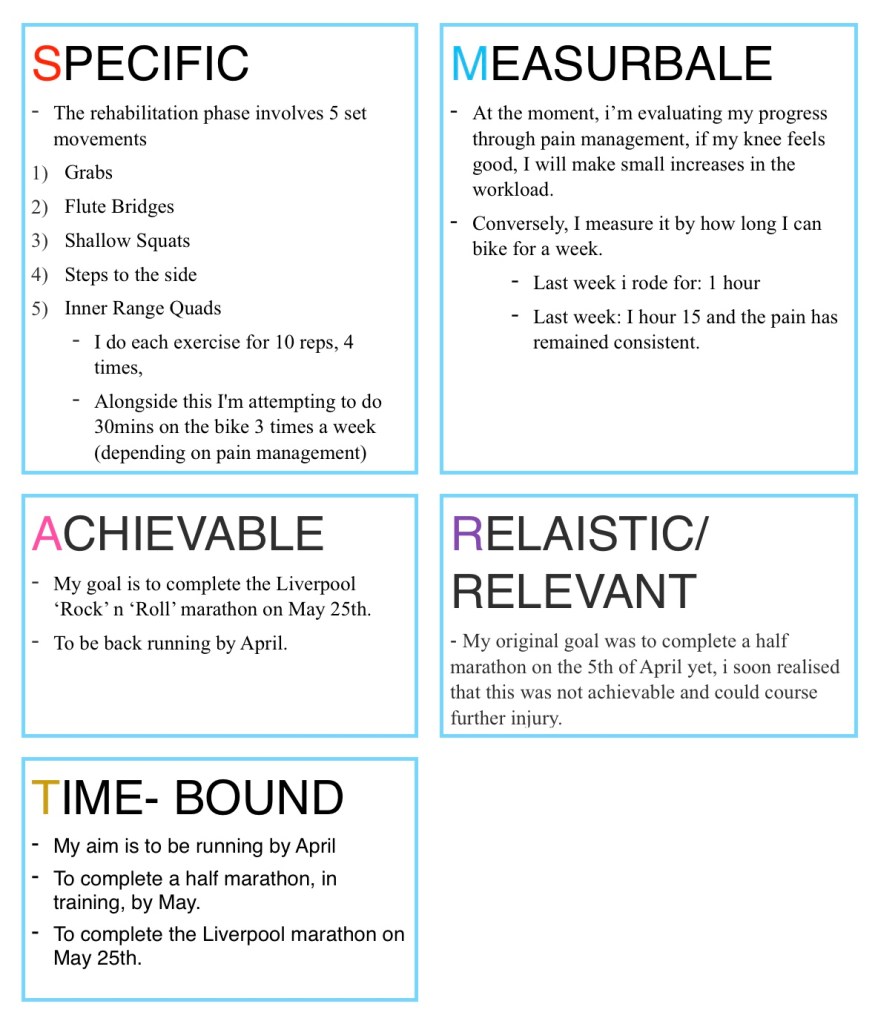
By setting SMART goals, most importantly setting realistic goals, has enabled me to rationalise the next three weeks, thereby increasing the likelihood of recovering and being able to run again effectively. Additionally, Wade and Halligan (2004) suggested that its key to acknowledge that goals are hierarchical in nature; the first of which is time: the separation of short-term (being able to run), medium-term (completing a half marathon), and long-term goals (completing a marathon). The second of which is on a conceptual level, such as maintaining psychological and physiological well-being through social participation and activities. Currently, social participation is crucial to maintaining my goals, even though by attending the Born to Run lectures on both a Monday and Tuesday tend to leave me feeling negative about myself through not completing runs or the Anglesey Half marathon, its clear that by failing to attend lectures I would begin to isolate myself from the group leading to a decrease in motivation.
Social isolation is referred to a complete or near-complete absence of contact between a society (Born to Run group) and an individual. Cacioppo (2014) measured the effects of social isolation within college students, showing that a perceived sense of exclusion can cause a heightened sensitivity to social threats, and can cause a decrease in motivation as well as impairing physical and mental wellbeing. This indicating that I need to continue to attend each week in order to maintain focus and motivation in the pursuit of achieving my goals in the long-term, as well as maintaining my enjoyment within the course that I have experienced thus far.
In the next 3 weeks, its imperative that I stick to my goals, without getting ahead of myself, to meet my short, medium and long-terms goals without any further setbacks. The module, up this point, has proven to be one of my biggest challenges, not physically, (ironic considering I can’t do anything because of my knee), but mentally, by picking myself back up repeatedly when I have the urge to give up.
References
Bovend’Eerdt, T. J., Botell, R. E., & Wade, D. T. (2009). Writing SMART rehabilitation goals and achieving goal attainment scaling: a practical guide. Clinical rehabilitation, 23(4), 352-361. Retrieved from: https://journals.sagepub.com/doi/pdf/10.1177/0269215508101741?casa_token=6frHVdMA9_QAAAAA:WNi9B-PGQuERk6tnf7sTiY3BXeir3xrDFzsDyB8h5t7zZL6jRjf1mWLM4pWArO_DAa14uVWICNCpvw
Shiell A, Hawe P, Gold L. Complex interventions or complex systems? Implications for health economic evaluation. Br Med J (Clin Res Ed) 2008; 336: 1281–83. Retrieved from: https://www.ncbi.nlm.nih.gov/pmc/articles/PMC2413333/
Locke EA, Latham GP. Building a practically useful theory of goal setting and task motivation. A 35-year odyssey. Am Psychol 2002; 57:705–17. Retrived from: http://farmerhealth.org.au/wp-content/uploads/2016/12/Building-a-Practically-Useful-Theory-of-Goal-Setting-and-Task-Motivation-A-35-Year-Odyssey.pdf
Hurn, J., Kneebone, I., & Cropley, M. (2006). Goal setting as an outcome measure: a systematic review. Clinical rehabilitation, 20(9), 756-772. Retrieved from: https://journals.sagepub.com/doi/pdf/10.1177/0269215506070793?casa_token=DsJbpY4gI-UAAAAA:DejeMRtUedsKN9dEUd5boaegqf-svMjdXNZahcX_RZigoPGPFCTvTLoExp51xJMKUHLfG4_dEzbjZw
Amiot, C. E., Gaudreau, P., & Blanchard, C. M. (2004). Self-determination, coping, and goal attainment in sport. Journal of Sport and Exercise Psychology, 26(3), 396-411. Retrieved from: http://selfdeterminationtheory.org/SDT/documents/2006_AmiotGaudreauBlanchard_JSpEP.pdf
Weinberg, R., Burton, D., Yukelson, D., & Weigand, D. (1993). Goal setting in competitive sport: An exploratory investigation of practices of collegiate athletes. The Sport Psychologist, 7(3), 275-289. Retrieved from: https://journals.humankinetics.com/view/journals/tsp/7/3/article-p275.xml
Smith, A., Ntoumanis, N., & Duda, J. (2007). Goal striving, goal attainment, and well-being: Adapting and testing the self-concordance model in sport. Journal of Sport and Exercise Psychology, 29(6), 763-782. Retrieved from: https://research.birmingham.ac.uk/portal/files/10761050/2007_Smith_Ntoumanis_Duda._Goal_Striving_Goal_attainment_well_being.pdf
Wade DT, Halligan PW. Do biomedical models of illness make for good healthcare systems? BMJ 2004; 329: 1398–1401. Retrieved from: https://www.ncbi.nlm.nih.gov/pmc/articles/PMC535463/
Cacioppo, J. T., & Cacioppo, S. (2014). Social relationships and health: The toxic effects of perceived social isolation. Social and personality psychology compass, 8(2), 58-72. Retrieved from: https://onlinelibrary.wiley.com/doi/pdf/10.1111/spc3.12087?casa_token=gu7YRU125n0AAAAA:8PM1WfEpEBsgrMdJEnI9rs0-1y1GjlNQFk898u4NGbwg6DzGenZE8nrw3mKBfLkvIHlr9JhwBzr5DKoE
Barry, B. (2002). Social Exclusion, Social Isolation, and. Understanding social exclusion, 13. Retrieved from: http://eprints.lse.ac.uk/6516/1/Social_Exclusion,_Social_Isolation_and_the_Distribution_of_Income.pdf
 Sarahs road to a marathon