Well coronavirus has well and truly messed everything up, I can honestly say I thought, compared to most, I would be well suited to lockdown. Yet, here I am, after only two days, trying to conjure up ways I can escape the house and keep from, attacking the fridge, (See Figure 1 for a picture of someone who’s enjoying lockdown a bit too much). For me, one good thing has come of all this mayhem; the marathon being moved to the 25th of October, giving more time to get back on track and complete 26.2 miles, which will take perseverance and grit. As Woody Allen famously said “80% of success is showing up”.

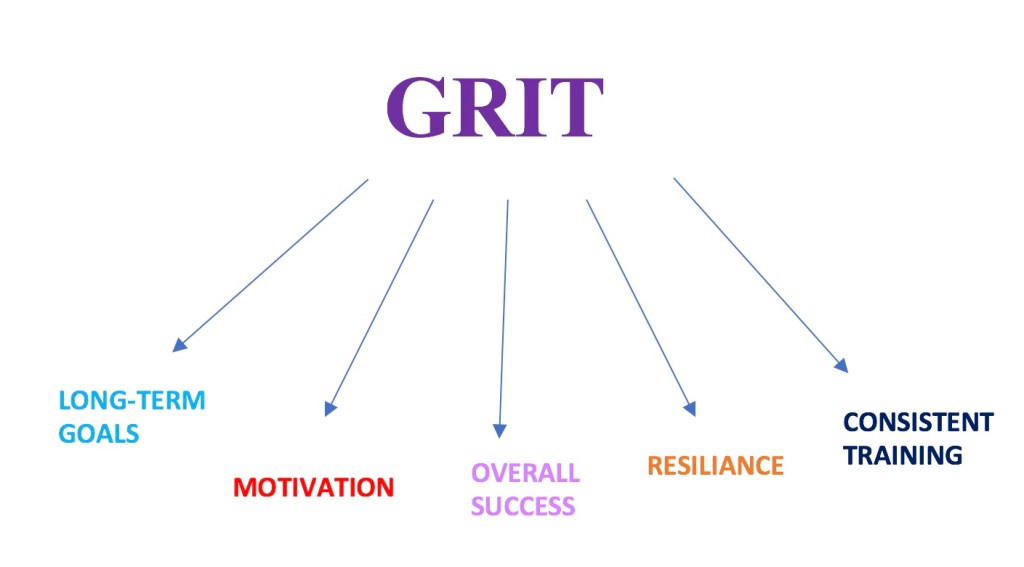
Larkin and colleagues (2019) defined grit as the passion and perseverance for long-term goals, entailing working tirelessly towards challenges, maintaining their interest and effort over months, regardless of adversity, failures and plateaus in progress. For me, the development of grit is essential for the upcoming months due to an increase in adversity through an injury, the challenge of getting back to running and coming to terms with starting my training program from the start, all the time maintaining my enjoyment throughout.
Scholars have suggested that people who possess the dispositional trait, grit, are increasingly likely to be successful in a range of adverse situations (Winkler, Shulman, Beal and Duckworth, 2014). Previously being associated with success in a range of domains; teacher effectiveness (Duckworth et al, 2009), academic performance at leading universities and sporting performance (Duckworth et al, 2007).
More specifically, Grit has been shown to predict achievement and perseverance over and beyond talent, distinguishing successful from less successful athletes. For instance, Conner and Williams (2015) examined whether soccer players who score low and high on the trait grit, can be distinguished based on perceptual-cognitive expertise and sport specific engagement. Results concluded that the grittier the individual the more time in sport-specific activities including training, competition, play and indirect involvement. Additionally, grittier players performed better in comparison to less gritty players on the assessment of situational probability and decision making. Additionally, Quinn and colleagues (2012) concluded that elite players accumulate considerably more time of sport-specific engagement in comparison to less skilled players. Thus, demonstrating a link between sporting performance and grit.
Conversely, while researchers have recognised the effects of grit in specific programs there is a lack of understanding of how grit effects performance, especially within endurance athletes (Eskreis-Winkler et al, 2014). However, the above studies present numerous methodological limitations reducing their reliability when applying to novice athletes like myself; for example, Conner and Williams (2016) sample was limited to elite youth payers presenting a homogenous groups, therefore limiting our knowledge about the relationship of grit and performance within diverse cohorts with ranging skill differences, such as subelite and novice performers.
Consequently, grit has shown to be key for increasing success in a range of domains, Duckworth and colleagues (2007) outlined three ways in which grit can be developed and maintained in the pursuit of long-term goals, which I will apply to my training over the foreseeable months. Primarily, coming to terms with the idea that frustrations are a necessary part of the process, when facing setbacks its key not to give up as it prevents the achievement of long-term goals. According to Duckworth “It’s by making those mistakes that you get better. Making mistakes and failing are normal- in fact they’re necessary.” Therefore, by analysing how you view your mistakes with the goal of learning from them and accepting them can lead to an increase in grittiness. Another method, is looking for ways to make your goals more meaningful, for me this entails writing down and continuously reminding myself why I wanted to run a marathon in the first place, for the feeling I will get when I cross that finish line knowing I persevered even when I wanted to give up, by doing this I will maintain my motivation and drive for training. Finally, is the belief that you can change and grow throughout training rather than obtaining a fixed mindset, this is linked to the belief that I will be fit enough to run a marathon come October due to continuous training and progression, even though at the minute I haven’t run for 6 weeks allowing myself to remain positive and to not give up on my goals.

I believe I already posses a high sense of grit, shown through my decision to continue training for the Liverpool Rock n Roll marathon despite numerous setbacks, like the current pandemic and an injury putting me out of training for over 6 weeks. Interestingly, research also suggests that grit can be learned, specific conditions can develop grit, allowing it to be transferred from one domain to another more challenging situation (Dweck, 2014). For me, swimming is a good example of how grit can be learnt from a young age. From the age of 13, I swam at regional and county level, training for over 16 hours a week both before and after school, as well as competing at weekends. This taught me the true meaning of grit from a young age and how perseverance within training can lead to the success and achievement of goals within the long-term and in times of hardship you always need to focus on the bigger picture. I have recognised that this has transferred over into my training for the marathon, knowing that hard work in the short-term will massively pay off in the future getting me over that finish line on October.
References
Eskreis-Winkler, L., Duckworth, A. L., Shulman, E. P., & Beal, S. (2014). The grit effect: Predicting retention in the military, the workplace, school and marriage. Frontiers in psychology, 5, 36. Retrieved from: https://www.frontiersin.org/articles/10.3389/fpsyg.2014.00036/full
Larkin, P., O’Connor, D., & Williams, A. M. (2016). Does grit influence sport-specific engagement and perceptual-cognitive expertise in elite youth soccer?. Journal of Applied Sport Psychology, 28(2), 129-138. Retrieved from: http://dx.doi.org/10.1080/10413200.2015.1085922
Duckworth, A. L., Quinn, P. D., and Seligman, M. E. P. (2009). Positive predictors of teacher effectiveness. J. Posit. Psychol. 4, 540–547. doi: 10.1080/17439760903157232.
Larkin, P., O’Connor, D., & Williams, A. M. (2016). Does grit influence sport-specific engagement and perceptual-cognitive expertise in elite youth soccer?. Journal of Applied Sport Psychology, 28(2), 129-138. Retrieved from: http://vuir.vu.edu.au/30841/3/Larkin%20-%202015%20-%20Accepted.pdf
Duckworth, A. L., Peterson, C., Matthews, M. D., & Kelly, D. R. (2007). Grit: perseverance and passion for long-term goals. Journal of personality and social psychology, 92(6), 1087. Retrieved from:https://wi01001304.schoolwires.net/cms/lib7/WI01001304/Centricity/Domain/187/Grit%20JPSP.pdf
 Sarahs road to a marathon